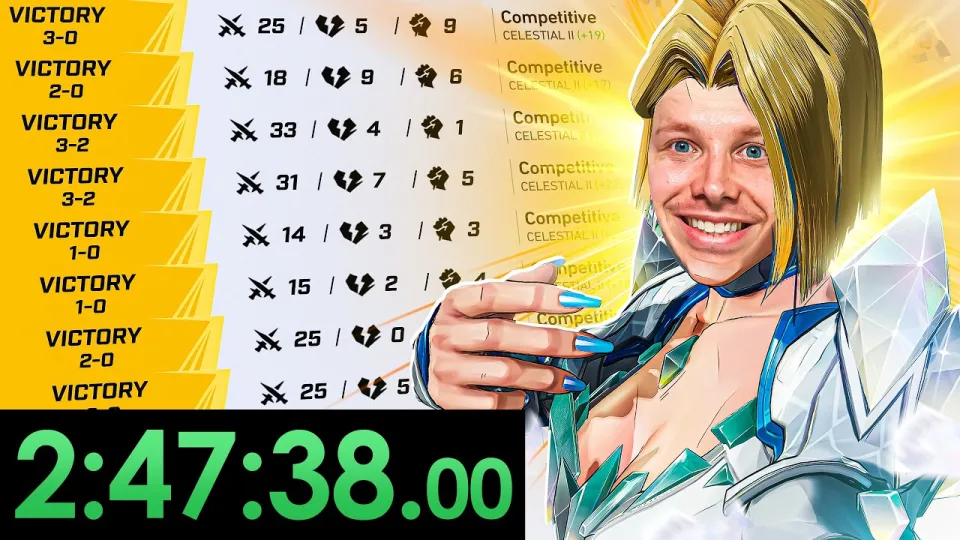
Marvel Rivals becomes a survival challenge where one loss ends the video and every match turns into a must-win
Want articles like this for your own video to promote it on YouTube and Google? Order them through the Telegram bot @sat_sit_bot. It writes articles around your video, embeds the video and publishes them on popular niche websites (no ads). Your first 50 articles are free.
Key takeaways
- The challenge rule is simple: a single loss in Marvel Rivals ends the video immediately.
- The format comes from Jay3, an Overwatch Grandmaster player who now mixes Marvel Rivals into his stream content.
- Marvel Rivals is a free-to-play 6v6 hero shooter from NetEase Games, launched in December 2024.
- Matches are short, so one bad round can end a run faster than in a longer competitive shooter.
- Viewer discussion around the video centers on ranked frustration, throwers and hero targeting.
Marvel Rivals becomes a survival test when a creator attaches a hard rule to it: lose one match and the video stops right there. That is the premise of Jay3's "IF I LOSE, THE VIDEO ENDS..." upload, where every queue is a must-win and a single bad round can cut the episode short. The format works because Marvel Rivals matches are short and swingy, so the pressure never really drops.
What the one-loss rule actually changes
A single loss ending the video turns an ordinary ranked session into a streak challenge. In a normal stream, a defeat is a speed bump: you queue again, adjust the pick, move on. Under this rule, the same defeat is the finish line, which changes how the player approaches drafts and risk.
Three things shift immediately:
- Hero selection becomes conservative. Comfort picks and proven team compositions beat experimental ones when there is no second chance.
- Ult economy matters more. Burning a defensive ultimate on a lost fight is far more costly when the next fight could be the last one of the episode.
- Tilt control becomes a skill. A player who argues in chat or chases a duel after a bad teamfight is one mistake away from ending the run.
Marvel Rivals is a 6v6 hero shooter from NetEase Games, free to play and built around team composition and destructible environments. Because a match can flip on a single well-timed ultimate, a one-loss format produces genuine tension rather than a formality.
Who is Jay3 and why the crossover matters
Jay3 built his audience as an Overwatch player, known for Grandmaster-level play and a Widowmaker and Sojourn background, and he has carried that aim-and-positioning skill set into Marvel Rivals. The crossover is not cosmetic: Overwatch habits such as tracking enemy ultimates, playing around cover and managing cooldowns translate directly into a hero shooter with a similar team-fight rhythm.
That background explains why the challenge is watchable. A player with strong fundamentals can rattle off several wins in a row, but the same fundamentals make the eventual loss more dramatic, because it usually comes from a structural mistake rather than a random fluke. The channel also runs a second, gameplay and VOD lineup alongside the main uploads, so the Rivals sessions sit next to the Overwatch content rather than replacing it.
Marvel Rivals ranked reality behind the challenge
The challenge format lands harder because Marvel Rivals ranked play has a reputation for volatility. Players climbing through the tiers regularly report matches decided by teammates who disconnect, refuse to swap heroes or deliberately sabotage the game, and the viewer response to this upload reflects exactly that mood.
The most common complaints from the player base:
- Throwers and off-role picks. A teammate locking a third duelist or abandoning the objective can decide a match before the first teamfight ends.
- Strange portal plays. Doctor Strange's portals are a signature Rivals mechanic, and a badly placed portal can dump a team off the map or into the enemy spawn.
- Ranked anxiety. Placement matches concentrate the frustration, since a short run of bad lobbies can define a whole season start.
- Targeting and focus. Enemy Spider-Man players hunting one specific opponent is a recurring grievance, and it is exactly the kind of pressure a one-loss run cannot absorb.
For a creator, this environment is content gold. The rule converts ordinary ranked chaos into a stake, and the audience knows a random thrower or a greedy flank can end the episode at any moment.
Typical viewer questions about the format
Viewers watching a one-loss challenge usually ask the same handful of things, and the answers are practical rather than technical.
Does the run end on any loss, including a disconnect or a leaver? In practice, most creators count the result on the scoreboard, but a game abandoned by a teammate is often treated as a grey area and replayed. The stated rule in the title is the headline; the fine print is usually decided live.
How long can a run realistically last? It depends entirely on matchmaking luck and role discipline. A player locked into a support or tank role with a coordinated duo can string together a long streak; a solo duelist queuing into chaotic lobbies is one bad teamfight from the end.
Why not just play safe and stall? Stalling loses objectives in Marvel Rivals. The mode rewards pressure and map control, so a defensive, low-risk approach often produces the exact loss the player is trying to avoid.
Is this an Overwatch channel now? No. The Rivals uploads sit alongside the Overwatch content, and the audience regularly asks for both, which is why the channel keeps a mixed schedule.
How to run the same challenge yourself
Anyone can copy the format, and it takes only a few decisions before the first queue.
- Set the stake in the title. A clear, binary rule (one loss, video over) is easier to follow than a points system.
- Pick a role you can carry from. Locking a comfort pick reduces the chance the run dies to a draft mistake.
- Record from the first match. The best moments in a one-loss run usually happen early, before nerves settle.
- Decide the leaver rule in advance. State on camera whether a teammate disconnect counts, so the audience does not argue about it later.
- Keep the run short. Three to five matches is enough for a single upload; longer sessions dilute the tension.
Where to find Jay3's streams and socials
All of the creator's links from the video are collected here for convenience:
- Twitch, for live streams: https://twitch.tv/jay3
- Twitter/X: https://twitter.com/jay3ow
- TikTok: https://tiktok.com/@jay3twitch
- Instagram: https://instagram.com/jay3twitch
- Discord community: https://discord.gg/jay3
Final thoughts on the Marvel Rivals survival run
A one-loss rule is a cheap, effective way to make a hero shooter feel dangerous again, and Jay3's Marvel Rivals upload shows why the format keeps returning. The challenge strips out the safety net of a rematch and forces every ultimate, every swap and every teamfight to carry real weight. It also exposes the parts of Rivals ranked that players complain about most, from throwers to portal mishaps, without needing a script. If you want to see the run play out live rather than in an edited upload, follow Jay3 on Twitch and catch the next session as it happens.
Questions & answers
What happens if Jay3 loses a match in the Marvel Rivals video?
The video ends. That is the entire premise of the format: a single defeat stops the episode, so every match is treated as a must-win. It turns an ordinary ranked session into a streak challenge where one bad teamfight can finish the upload.
What is Marvel Rivals and why does it suit this challenge?
Marvel Rivals is a free-to-play 6v6 hero shooter from NetEase Games built around team composition and destructible maps. Matches are short and can flip on one ultimate, which makes a one-loss rule genuinely tense instead of a formality.
Why do viewers complain so much about ranked in Marvel Rivals?
The common complaints are throwers, off-role picks, players abandoning the objective and badly placed Doctor Strange portals that dump a team off the map. Placement matches concentrate that frustration because a short run of bad lobbies shapes a whole season start.
Is Jay3 still an Overwatch player or has he switched to Marvel Rivals?
He remains an Overwatch-focused creator with a Grandmaster background, and the Marvel Rivals sessions sit alongside that content rather than replacing it. His aim, cooldown tracking and team-fight habits carry over directly between the two hero shooters.
Source: IF I LOSE, THE VIDEO ENDS... (Marvel Rivals) · Markdown version